Flatbed vs wheel-lift towing: which is safer?
Each is a valid towing method, but choosing incorrectly can seriously damage your car. This plain-English guide explains which vehicles require each method and when to reject a wheel-lift, even if the operator approves it.
What you'll learn
- When a wheel-lift is fine (and saves you money)
- AWD, EV, lowered, damaged: always use a flatbed
- When "drive-wheels-up" wheel-lift towing is safe
- Why some operators favor wheel-lift when flatbed is right
- Signs a tow operator may be about to use the wrong method
Step by step
- AWD, 4WD, electric, or hybrid? Ask for flatbed.
- Lowered, modified, or low-clearance? Choose flatbed.
- Wheel or suspension damaged? Request a flatbed.
- Over 30 miles? A flatbed is the safer choice.
- For a standard FWD or RWD vehicle traveling under 30 miles, a wheel-lift is generally safe when the drive wheels remain off the road.
- Unsure? Pay the modest extra cost for a flatbed. A drivetrain repair costs $2,500+.
For any EV, including a Tesla, Rivian, Lucid, or Mustang Mach-E, follow the manufacturer’s manual and use a flatbed every time. Wheel-lifting an EV may ruin its drive motors. Tow Pro Houston only matches EV callers with independent operators offering flatbed service.
The quick answer
For most newer vehicles, a flatbed is the safer option. A wheel-lift can suit an older two-wheel-drive sedan traveling a short distance. Although the local price difference is real, it is generally modest, and the independent operator provides the total price before sending the truck for either method. Replacing an AWD transfer case damaged by improper wheel-lift transport costs $2,500 to $4,500. The comparison is clear.
What each towing method does
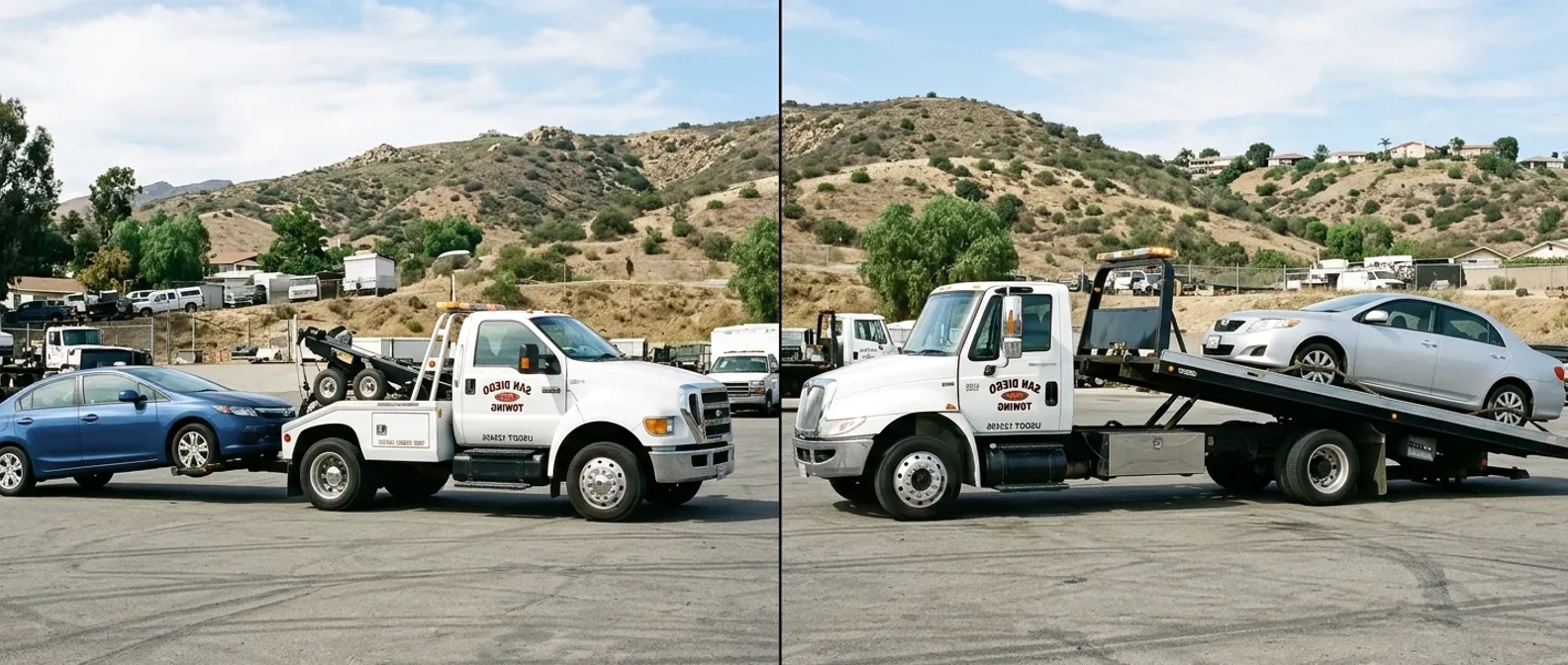
Flatbed (rollback) towing relies on a hydraulically tilting deck that comes down to ground level. The independent operator winches the disabled vehicle onto the ramp, then fastens all four wheels with soft-strap tie-downs. Every wheel is raised off the roadway, so nothing trails behind and the drivetrain does not rotate during the trip.
Wheel-lift towing involves a hydraulic yoke placed beneath two wheels, either at the front or rear, which are then raised from the pavement. The remaining pair stays down and rolls behind the truck in the manner of a trailer. To prevent drivetrain damage, the powered wheels - those receiving engine power - have to be the raised pair.
The vehicle-by-vehicle matching rule
| Vehicle type | Method we request | Reason |
|---|---|---|
| Front-wheel-drive sedan (Civic, Corolla, Accord, Camry) | Wheel-lift for short hauls; flatbed beyond 30 miles | Front drive wheels are raised while rear wheels turn freely |
| Rear-wheel-drive sedan (older BMW, Mustang, 240SX) | Flatbed OR wheel-lift with the rear wheels raised | The powered wheels stay off the road |
| All-wheel-drive (Subaru Outback, BMW xDrive, Acura SH-AWD, every modern Audi) | Flatbed exclusively | A wheel-lift can harm the transfer case and center differential |
| 4WD truck/SUV (F-150 4x4, Tacoma, Wrangler, 4Runner) | Flatbed; OR wheel-lift after disconnecting both axles | The transfer case is at risk; most operators normally choose a flatbed |
| Any electric vehicle (Tesla, Rivian, Lucid, Cybertruck, Hummer EV, Mach-E, Lightning) | Flatbed only - every time - without exception | Manufacturer manuals expressly bar wheel-lifting because it may destroy the drive motors |
| Plug-in hybrid (Prius Prime, Volt, Pacifica Hybrid) | Flatbed exclusively | Full EVs and plug-in hybrids share the drive-motor concern |
| Lowered, modified, or sports car (lowered Civic, Type R, Supra, GT-R, 911) | Flatbed exclusively | A wheel-lift’s approach angle can scrape the undertray and front lip |
| Exotic / classic / collector (Ferrari, Lambo, vintage Corvette, restored 911) | Flatbed - with a covered trailer available by request | Paint, suspension, and body damage cannot be risked |
| Damaged vehicle (collision, flat tire, broken suspension, locked-up wheel) | Flatbed | A wheel-lift depends on working, rolling wheels on the axle left down |
EV maker towing requirements (verbatim sources)
- Tesla (Model S, 3, X, Y, Cybertruck): "Tesla vehicles must be transported on a flatbed truck. Tesla vehicles must never be transported with the wheels on the ground." (Tesla Owner’s Manual)
- Rivian (R1T, R1S): A flatbed is required. The manual includes the process for moving one when ignition power is unavailable.
- Lucid (Air): A flatbed is mandatory. Through Lucid Connected Services, Lucid Service can send one.
- Ford Mustang Mach-E, F-150 Lightning: A flatbed is required. Ford Roadside sends operators equipped with flatbeds.
- Chevy Bolt, Blazer EV, Silverado EV: A flatbed is mandatory.
- Hyundai Ioniq 5/6, Kia EV6/EV9, Genesis GV60: A flatbed is mandatory.
- BMW iX, i4, i5: A flatbed is mandatory.
- VW ID.4, Audi e-tron, Porsche Taycan: A flatbed is mandatory.
Decline the job and contact someone else if an operator proposes wheel-lifting one of these vehicles. You may be left paying for the drivetrain damage because the operator’s release form commonly assigns that responsibility to you.
Five frequent towing-method errors
- Using a wheel-lift on AWD "because it’s just five miles." A transfer case can be ruined within five miles. Repairs cost $2,500 to $4,500, far more than any possible savings from avoiding a flatbed.
- Putting an EV on a wheel-lift. The result is similar, but the repair is costlier. Replacing EV drive motors runs $3,500 to $9,000 per axle.
- Wheel-lifting a lowered vehicle. The mechanism will scrape its undertray and front lip. Replacing those parts on a Type R or Supra costs $800 to $1,500.
- Accepting a wheel-lift after a crash has damaged a wheel or tire. A compromised wheel cannot safely turn behind the truck and may separate from its hub during transport. Use a flatbed after every collision.
- Taking "wheel-lift is fine for your car" at face value without reading the manual. Training varies among tow operators. Treat your owner’s manual as the authority and insist on a flatbed whenever it requires one.
Typical 2026 Houston-area cost differences
| Service | Wheel-lift | Flatbed | Tow Pro Houston referral |
|---|---|---|---|
| Local hook (under 10 miles) | Operator-dependent | Operator-dependent | The matched operator quotes wheel-lift or flatbed service before sending the truck |
| Mid-distance (10-30 miles) | Mileage plus hookup | Mileage plus hookup | The operator quotes hookup plus mileage before sending the truck |
| Long-distance (over 30 miles) | Not advised | Operator-dependent | The operator bases pricing on the vehicle and distance |
| Night/holiday surcharge | Some operators apply one | Some operators apply one | Ask the operator to confirm before the truck is sent |
| EV/AWD upcharge | N/A (declined) | Operator-dependent | Confirm any charge directly with the operator |
Texas rules governing towing methods
At the statutory level, Texas does not prescribe flatbed or wheel-lift service according to vehicle type. Selecting a safe method is the operator’s duty. Tow trucks and operators are licensed by the Texas Department of Licensing and Regulation (TDLR), which requires suitable equipment for safely moving the vehicle being towed. Reputable operators in Houston have wheel-lift and flatbed equipment available for the variety of vehicles assigned to them.
When an operator’s incorrect method damages your vehicle, you may have a claim under that operator’s commercial insurance. TDLR rules require licensed Texas tow operators to maintain liability coverage and on-hook cargo coverage.
Situations where wheel-lift IS appropriate
- A FWD sedan traveling 5-10 miles to a repair shop
- A RWD vehicle whose rear wheels can be raised, keeping its drive wheels off the pavement
- Restricted residential parking where a flatbed cannot turn - an independent operator can use a wheel-lift to reach a broader street, then move the vehicle onto a flatbed for the long-haul segment
- An apartment garage with limited overhead space - a flatbed requires 12+ feet, while a wheel-lift fits within 9 feet
- A quick repo or out-of-fuel move when the vehicle operated normally before the request
The right question to ask a tow operator
When contacting any operator, including one matched through Tow Pro Houston, provide these four details to the dispatcher in this sequence:
- The vehicle’s year, make, model, and trim, since the trim identifies AWD, a sport package, or a lowered configuration.
- Whether the vehicle is electric or hybrid, which is the key detail.
- The event involved - dead battery, collision, flat tire, mechanical failure, or running out of fuel.
- Where you are and the destination where the vehicle should go.
A capable dispatcher explains both the method being sent and the reason for it. Treat an offer to wheel-lift an AWD vehicle or EV as a warning and contact a different operator.
Why Tow Pro Houston requests flatbed first
Tow Pro Houston prioritizes matching callers with independent operators offering flatbeds for two reasons. First, over half the calls received involve vehicles that need flatbeds regardless of mileage because today’s metro vehicle mix includes Tesla, BMW xDrive, Audi quattro, Subaru, Acura SH-AWD, and every modern luxury SUV. Second, any difference in the operator’s wheel-lift and flatbed prices does not make drivetrain damage worth risking. A wheel-lift is requested only when the caller wants one and the vehicle is suitable.
Rather have a pro handle it?
At any hour, callers are matched with licensed local operators for towing and roadside help across the Houston metro.
Keep learning.
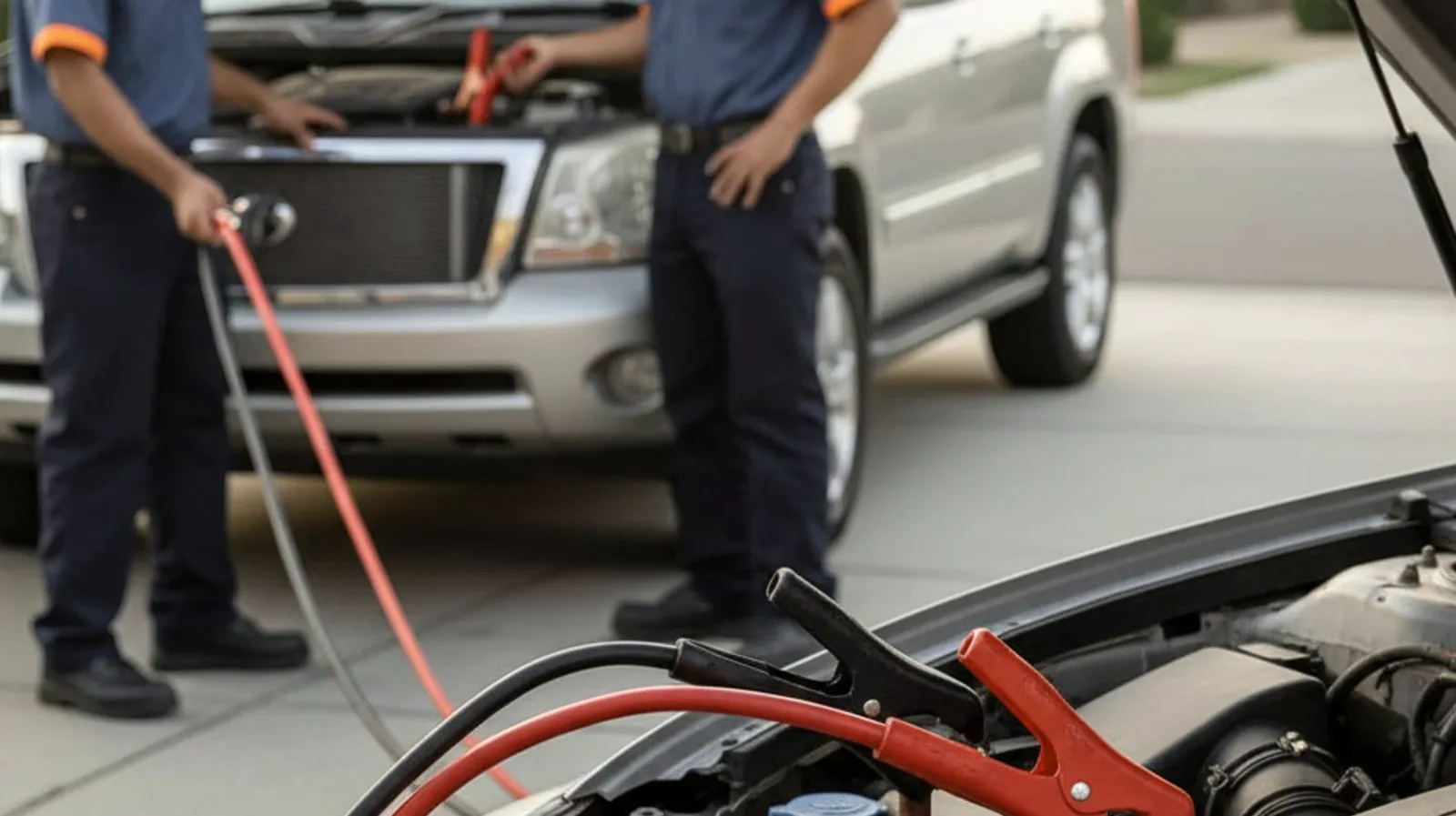
Jump-start a dead battery safely
Jumper cables seem easy until the connections are wrong. Connect them correctly to prevent sparks, damaged electronics, and an unnecessary tow.
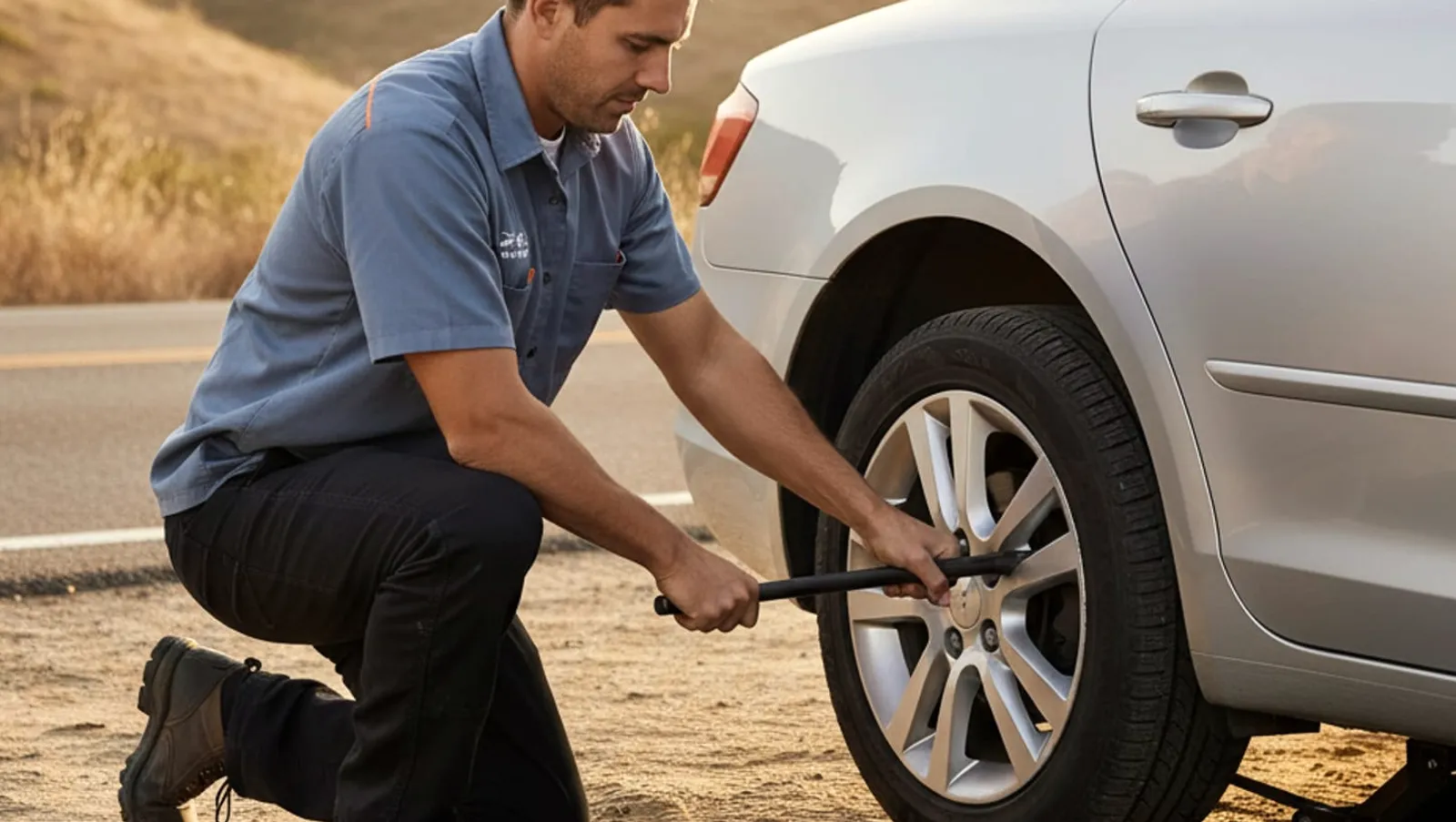
Change a flat tire on the side of the road
Knowing the spare and jack locations ahead of time can mean a 20-minute shoulder stop instead of spending an hour calling a tow company.
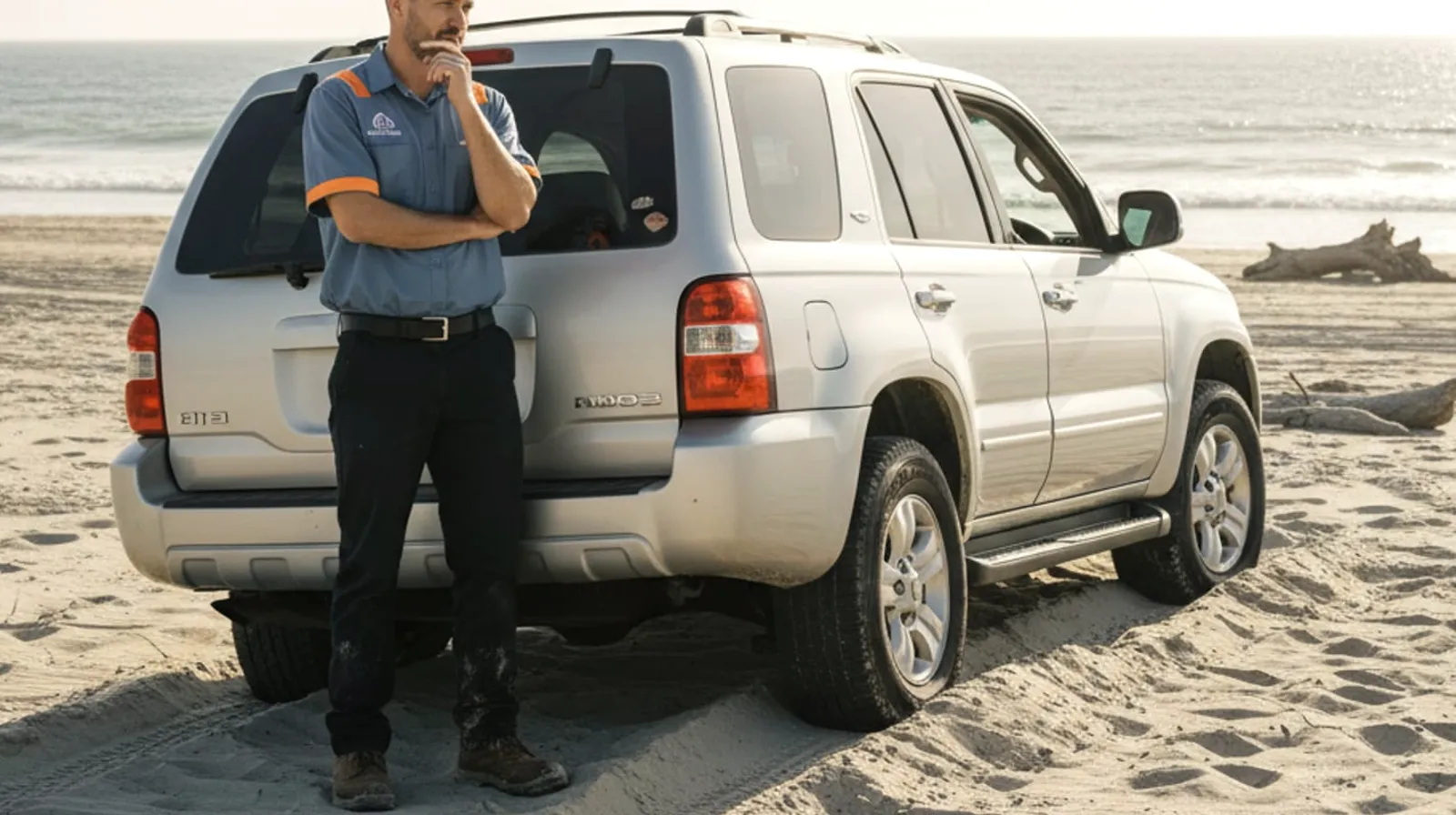
What to do when stuck in mud or high water
During heavy rain, low-lying streets, bayou crossings, and unpaved lots can quickly fill with mud and standing water. Start by not worsening the situation.