Texas Occupations Code 2308 addresses several parts of Texas towing regulation. The confirmed provisions below cover operator licensing, private-property signs, and hearings after a vehicle is towed or booted without consent. It isn’t a complete answer for every removal, fee, or storage dispute.
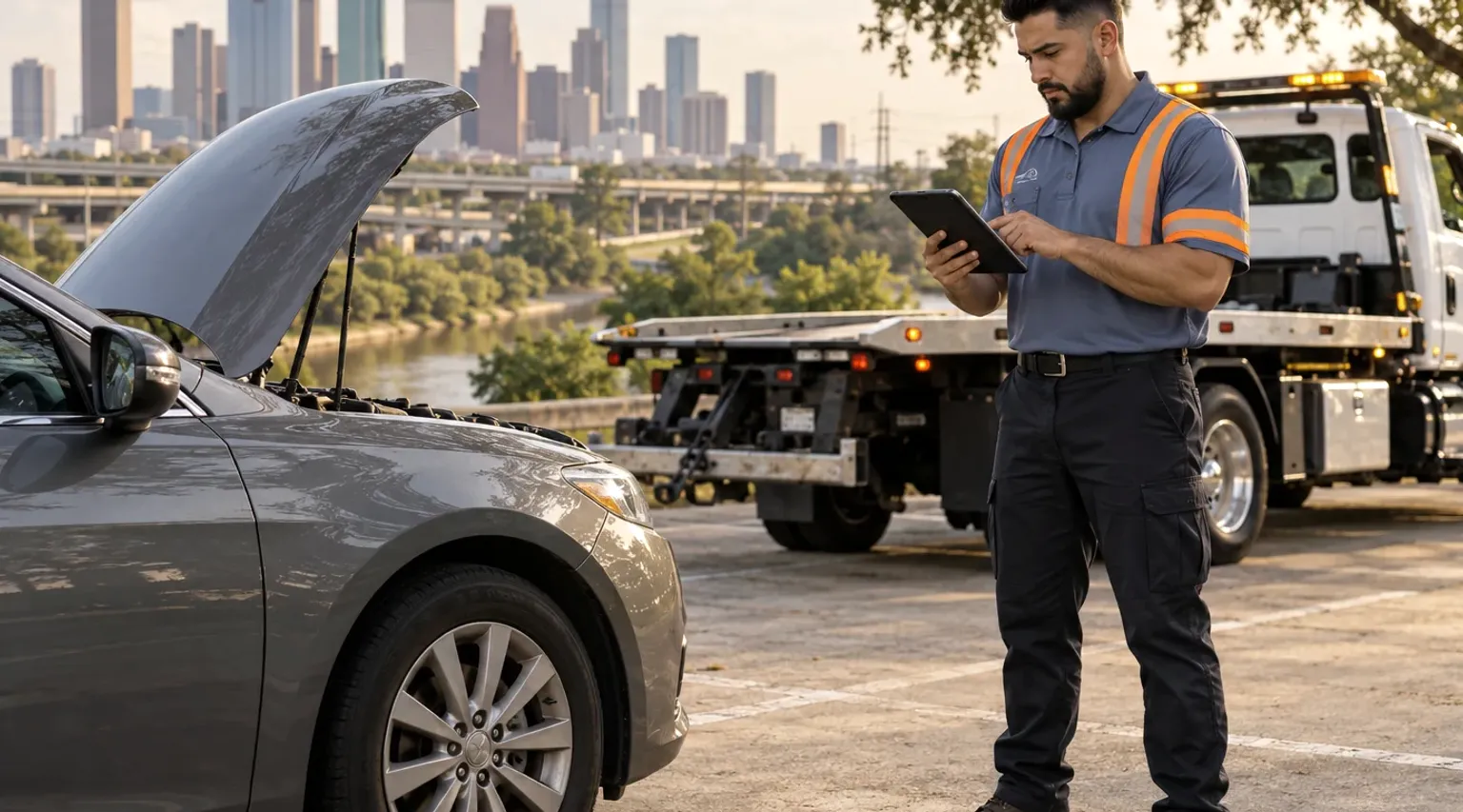
Identify the towing situation before applying a rule
Start with what happened, where it happened, and who requested the tow. Those details help identify which confirmed rule may apply. Don’t begin with a code section pulled from an unrelated dispute.
A vehicle removed from an apartment lot in Gulfton presents a different issue from a disabled car on I-45. A private parking dispute in the East End also differs from a police-directed removal after a collision. The same is true for a stalled vehicle handled through Houston’s freeway-assistance program.
Write down several basic facts:
- The exact location where the vehicle was parked
- Whether the driver agreed to the tow
- Who requested or directed the removal
- Whether signs were posted at the parking entrance
- The date the vehicle was removed or booted
- The name of the operator and storage facility
- Every document provided by the operator or facility
Keep photos of the entrance, signs, parking space, curb, and surrounding area. Save receipts, notices, and messages without altering them. These records may matter if you later request a tow hearing.
Texas requires tow operators to hold a TDLR license. The three confirmed license types are Incident Management, Private Property, and Consent Tow. You can check a towing license through TDLR.
The license category alone doesn’t decide whether a particular removal was lawful. It also doesn’t establish whether a posted sign complied with the applicable requirements. Those questions depend on the facts and the current official text.
Tow Pro Houston doesn’t interpret the law, authorize private-property removals, or decide disputes. We dispatch and refer callers to licensed, insured operators. The customer contracts directly with the operator performing the work.
Separate private-property towing from other removals
The confirmed Chapter 2308 provisions in this guide are especially relevant when a vehicle was removed from a private parking facility without the driver’s consent. That may include a vehicle taken from an apartment, retail lot, or assigned parking area. The facts still determine which provision matters.
Private-property sign requirements are specific. A compliant sign must be visible to drivers entering the parking facility. A sign is required at each driveway or curb cut. If an entrance is wider than 35 feet, signs must appear every 25 feet.
The sign must be permanently mounted between 5 and 8 feet above the ground. It must be weather-resistant and measure at least 18 inches wide by 24 inches tall. It must also include:
- The international towing symbol
- Who may park and the applicable prohibition
- The days and times enforcement applies
- A 24-hour telephone number with an area code
These are confirmed requirements from Texas Occupations Code §2308.301. Other sign details or exceptions couldn’t be confirmed from the approved claims file. Check the current official Chapter 2308 text before relying on a summary.
A missing or noncompliant sign may be raised during a tow hearing. Sections 2308.301 through 2308.305 address the confirmed sign provisions, while §2308.404 provides for civil liability when those provisions are violated. Whether a violation occurred in a specific case isn’t something Tow Pro Houston can decide.
Property owners seeking removal help should use a licensed operator familiar with private-property towing in Houston. An operator can explain its process and required documentation. Questions about legal authority should go to a qualified Texas attorney.
Use only the provisions confirmed in the claims file
Texas Occupations Code 2308 is broader than the few provisions summarized here. This page doesn’t treat search results, parking-lot notices, or another towing company’s website as legal authority. It uses only confirmed material tied to official Texas sources.
The confirmed statewide licensing rules require tow operators to be licensed by TDLR. Licenses remain valid for one year. Operators complete four hours of continuing education each year. They must display their TDLR license and wear reflective gear while working outside the truck.
Vehicle Storage Facilities, often called VSFs, must also be licensed by TDLR. A VSF must be fully enclosed by a six-foot fence. Its gate must be locked when the facility isn’t staffed. Those storage-facility requirements come from 16 TAC Chapter 85, not from the confirmed Chapter 2308 provisions summarized above.
Government fee rules also require careful sourcing. Chapter 2308 shouldn’t be treated as a complete rate sheet. TDLR publishes statewide maximum non-consent towing charges through its rules and consumer towing information.
The confirmed statewide maximums are $272 for vehicles weighing 10,000 pounds or less and $380 for vehicles weighing 10,001 through 24,999 pounds. For vehicles weighing 25,000 pounds or more, the maximum is $489 per unit, with a $978 maximum. These are TDLR caps under 16 TAC Chapter 85, effective January 1, 2024.
The corresponding drop fees are $135, $190, and $244 by those weight classes. A drop fee concerns a vehicle that has been hooked but not removed. TDLR also permits a one-time $50 notification fee.
Those figures aren’t Tow Pro Houston prices. We don’t set towing rates or collect these government-authorized charges. The operator sets and quotes its price. Confirm the amount and applicable authority directly with that operator before dispatch or vehicle pickup.
Connect signs, notices, and disputes to separate guides
Signs, notices, storage, and tow hearings are related, but they’re separate issues. A sign question doesn’t automatically answer a storage-fee question. A storage notice also doesn’t determine whether probable cause existed for the original tow.
A driver whose vehicle was towed or booted without consent is entitled to a hearing on whether probable cause existed. The written hearing request must be filed with the court before the 14th day after removal, excluding weekends and holidays. That deadline begins only after the towing operator or VSF provides the information needed to file.
The hearing takes place in a justice court in the county where the vehicle was towed. In Houston, that means the location of the removal matters. Don’t choose a court solely from the storage facility’s address or the driver’s home address.
Drivers should preserve the paperwork provided at release. Photograph parking signs before conditions change. If the dispute concerns an assigned space, our guide to someone parking in your assigned Houston space explains practical next steps without deciding legal rights.
Registration-related disputes also need separate treatment. Don’t rely on an unverified online summary about apartment parking. Start with our guide to the expired-registration towing question in Texas, then compare the issue against the current official code or speak with a Texas attorney.
Storage notices follow their own confirmed rules. A vehicle in a storage facility is considered abandoned after the 10th day following mailed notice under Texas Transportation Code Chapter 683. No more than five storage days may be charged until notice is mailed. Our guide to unclaimed towed vehicles in Texas covers that process separately.
Check the current official text before acting
A plain-language guide helps organize the problem. It shouldn’t replace the current statute, TDLR rules, court instructions, or advice from a qualified Texas attorney.
Before acting, compare your records with the official sources. Confirm that you’re reading the current version. Check the effective date and identify whether the text concerns towing, booting, storage, signage, licensing, fees, or hearings.
Local authority matters too. Houston has no single city-operated impound lot. Police and city tows go to a network of licensed private Vehicle Storage Facilities. Use the city vehicle lookup rather than assuming one facility receives every vehicle.
City and state fee sources must also remain separate. Inside the City of Houston, the confirmed light-duty non-consent rate is $232 for the first 20 miles, followed by $4.64 per mile beyond 20. That municipal rate took effect January 1, 2026, under Houston Municipal Code §8-123. It is adjusted each January 1 through a weighted CPI formula.
That city rate isn’t a Tow Pro Houston price. It also shouldn’t be substituted for the TDLR statewide caps in a different situation. Ask the operator which authority applies and confirm the current amount before paying.
Some online explanations discuss apartment-specific removals, written authorization, registration notices, kickbacks, or detailed legal definitions. Those provisions couldn’t be confirmed from the approved claims available for this page. We won’t repeat them as facts. Review the current official Texas text or ask a qualified Texas attorney about your specific situation.
If you only need towing rather than legal guidance, describe the vehicle, location, and circumstances accurately. We can route the request to an operator serving that part of the Houston area. The operator can provide an arrival estimate and quote before dispatch.
When to call us
Call when you need a licensed towing operator for a private-property removal or another lawful tow. We can connect you with an insured operator, but we don’t authorize removals or decide legal disputes. Call us at (346) 443-5499 and we’ll connect you with an operator who handles this work.