The cost to get a car out of impound in Houston depends on the tow, storage time, and facility charges. There isn’t one citywide total or one Houston impound lot, so find the vehicle and request its current itemized balance first.
Identify which facility has the vehicle
Houston doesn’t operate one central impound lot. Police and city tows go to a network of licensed private Vehicle Storage Facilities, known as VSFs. Your first task is finding the specific facility holding your car.
For a vehicle towed within the City of Houston, search findmytowedcar.com using the plate or VIN. The lookup is generally updated within about two hours of a tow. If nothing appears immediately, check the plate entry for errors and try the VIN.
Location matters across the Houston area. A vehicle removed inside city limits may follow Houston’s municipal non-consent rate. A tow from unincorporated Harris County falls under a different local jurisdiction. Pasadena, Galena Park, and other incorporated cities can also have their own rules. Don’t assume that a tow near Houston happened under Houston city authority.
The receipt, parking sign, property manager, or responding agency may identify the storage facility. For a private-property removal, inspect the sign at the parking entrance. Texas law requires qualifying tow signs to include a phone number. It also sets rules for their placement and content.
If the car disappeared from an apartment complex, store, or restricted lot, our guide to private property towing explains that type of removal. Tow Pro Houston doesn’t store vehicles or collect release fees. The licensed VSF holding the car controls its release process.
Before traveling, confirm the facility name and physical location directly. Houston’s freeway network can turn a mistaken address into a long trip. That matters when the car was removed near I-10, Loop 610, or the Ship Channel.
Ask for the current itemized charges
Call the storage facility and request the current itemized charges. Ask it to separate the towing charge, daily storage, impoundment fee, notification fee, and any other listed item. Don’t rely on an online average or a sample total.
Texas Department of Licensing and Regulation figures currently verified in the claims ledger took effect January 1, 2024. For vehicles measuring 25 feet or less, the approved daily storage fee is $22.85. For vehicles over 25 feet, it is $39.99 per day. The impoundment fee is $22.85, and the notification fee is $50.
Storage begins six hours after the vehicle reaches the VSF. A partial day can count as a day. However, a period under 12 hours can’t produce more than one storage day. No more than five storage days may be charged until owner notice is mailed.
Those rules explain why timing changes the Houston impound release cost. They don’t establish your final balance. The tow itself may fall under a city rate or a statewide cap. The vehicle’s length and time at the facility also matter.
Ask the facility when the vehicle arrived and when storage started. Request each charge by name. TDLR prohibits environmental fees, notary fees, and fees for accessing personal property inside a stored vehicle. Its towing consumer information explains the state framework.
No verified general rule in the approved claims ledger confirms every facility’s payment methods. Ask which forms of payment that specific VSF accepts. Also ask whether the quoted balance changes before your planned arrival. The facility, not Tow Pro Houston, calculates and collects the release amount.
Check which documents the facility requests
Document requirements can depend on the facility and the person’s connection to the vehicle. The approved claims ledger doesn’t confirm one universal document checklist for every Houston VSF. Ask the facility what it requires before leaving home.
Start with the plate number or VIN when you call. Then ask what proves identity and authority to retrieve the car. If the registered owner can’t appear, ask whether the facility accepts another person and what paperwork it requires. Don’t assume a photo, digital copy, or verbal permission will work.
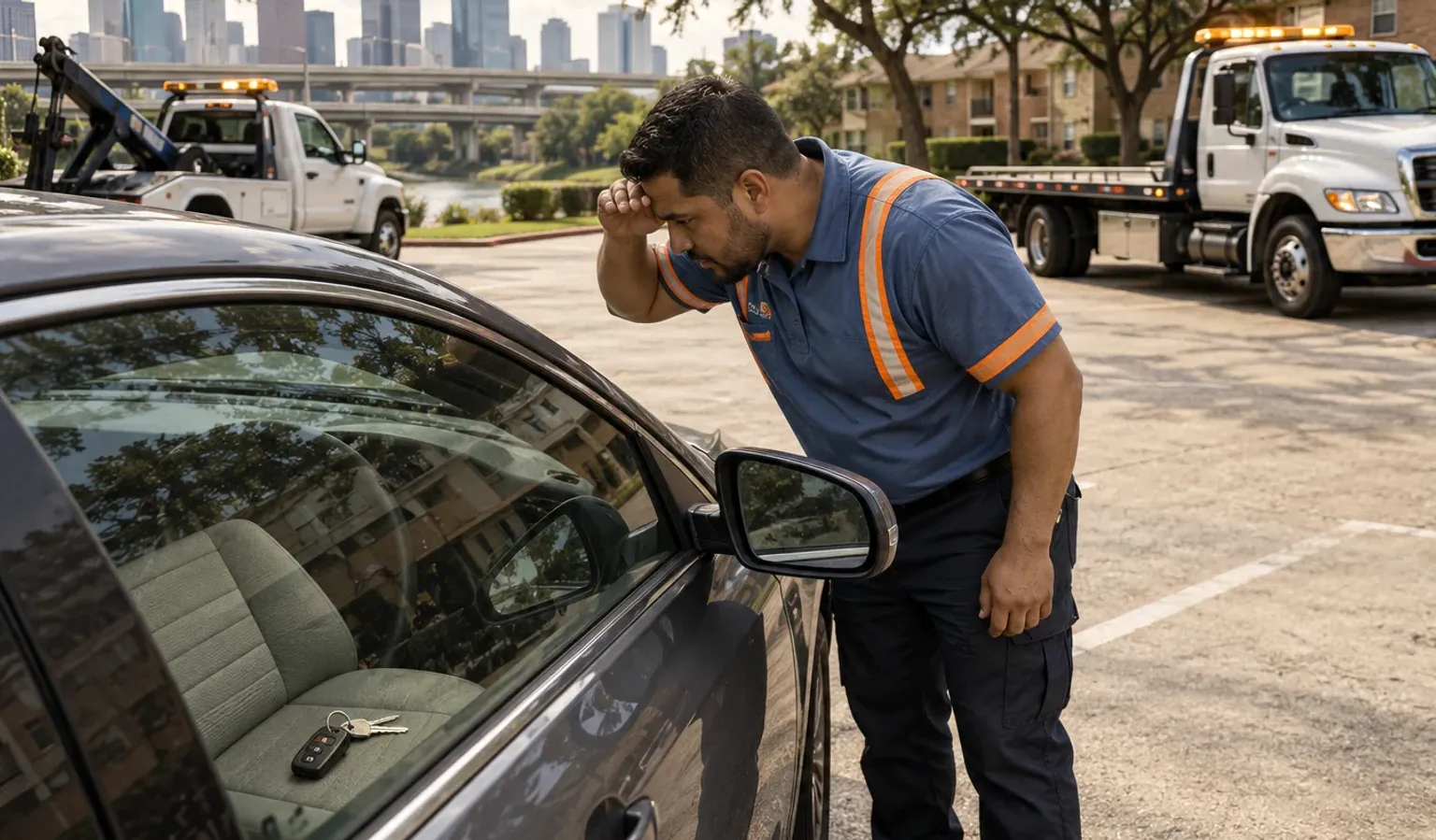
Also explain any issue that could affect release. Examples include missing keys, documents locked inside the car, or a damaged vehicle that can’t be driven. Accessing personal property is different from releasing the vehicle. TDLR rules prohibit a fee merely to access personal belongings in a stored vehicle, but you should still ask about the facility’s access procedure.
If the car was damaged, ask whether it can leave under its own power. A vehicle with collision damage, missing wheels, steering problems, or flood exposure may need a licensed towing operator after release. The storage facility can explain its gate procedure, while the receiving operator can explain the transport requirements.
Houston geography matters here too. A vehicle stored near the East End or Ship Channel may be far from its owner in Katy or Spring Branch. Confirm the documents before crossing the city. The same caution applies to drivers traveling north from Clear Lake or the Bay Area.
Write down the name of the facility representative and the requested documents. That note isn’t a guarantee of release, but it can help you prepare. Confirm the list again if someone else will retrieve the car.
Separate government caps from operator pricing
Government towing limits aren’t the same as a Tow Pro Houston price. We dispatch and refer callers to licensed, insured operators. We don’t own a yard, release stored vehicles, set facility policies, or collect impound charges.
For a light-duty non-consent tow inside the City of Houston, the municipal rate effective January 1, 2026, is $232 for the first 20 miles. The rate is $4.64 per mile beyond 20 miles. Houston adjusts this municipal rate each January using a weighted inflation formula.
Texas also publishes statewide maximum non-consent towing charges. The cap is $272 for a vehicle weighing 10,000 pounds or less. It is $380 for a vehicle from 10,001 through 24,999 pounds. For a vehicle weighing at least 25,000 pounds, the cap is $489 per unit, with a $978 maximum.
The correct figure depends on where and why the tow occurred. For a tow inside Houston city limits, use the applicable Houston municipal rate. For private-property non-consent towing elsewhere in the metro, the TDLR statewide caps may apply. Don’t combine both figures into a made-up total.
Texas also sets drop-fee caps when a vehicle has been hooked but not removed. Those caps are $135, $190, and $244 across the same weight classes. Houston’s hook-up-only release rule instead provides half the regular city fee when the owner arrives before the tow begins.
These figures concern regulated non-consent towing. They aren’t Tow Pro Houston rates, and they don’t establish what a voluntary transport costs. For a requested tow after release, the operator sets and quotes its own price before dispatch. Confirm that amount directly with the operator.
Confirm the total with the facility before visiting
Call the VSF again shortly before you travel. Ask for the current total and every item included. Confirm the vehicle is available for release and that you have the requested documents.
Also ask for the facility’s current access and release hours. No universal Houston VSF schedule could be confirmed from the approved claims ledger. Don’t assume the office follows another facility’s hours or remains open when its storage lot is occupied.
Confirm the accepted payment methods directly. Ask whether storage will add another daily charge before you arrive. If the amount changed since your first call, request a fresh itemized explanation. Keep receipts and any release paperwork.
If you believe a private-property tow lacked proper signage, document the entrance and parking area. Texas requires qualifying signs at each driveway or curb cut, with added placement rules for wide entrances. Signs must be visible to entering drivers and contain specified towing information.
A person whose vehicle was towed or booted without consent has a right to a hearing on probable cause. The written request must be filed with the proper justice court before the 14th day after removal, excluding weekends and holidays. That clock starts only after the towing company or VSF provides the information needed to file.
A hearing request doesn’t replace the facility’s release process. Ask the VSF for the information needed to contest the tow, then follow the applicable court procedure. Keep photographs, receipts, notices, and written charge details.
Act promptly even if you’re disputing the tow. Under Texas law, a stored vehicle becomes abandoned after the tenth day following mailed notice. Storage charges are limited to five days until that notice is mailed, but delay can still affect the amount due and the vehicle’s status.
When to call us
Call when a released vehicle can’t be driven or needs transport from the storage facility. Tow Pro Houston will route your request to a licensed, insured operator, and that operator will set the price and confirm the job details before dispatch. Call us at (346) 443-5499 and we’ll connect you with an operator who handles this work.